
How to Use Dedicated IPs for Multiple WhatsApp Accounts
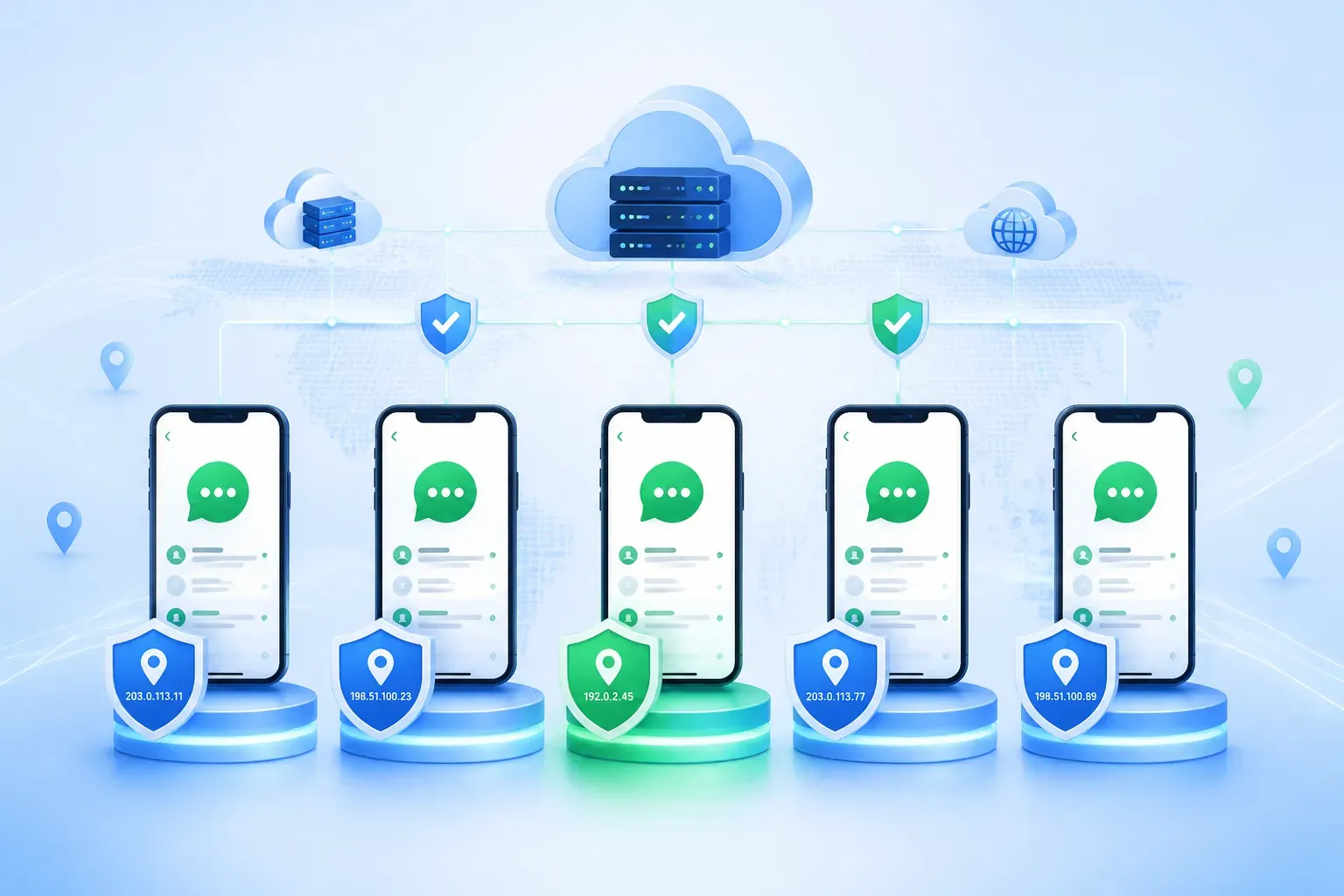
Many people in foreign trade and cross-border business run into similar problems after managing multiple WhatsApp accounts for a while.
An account may suddenly face restrictions even when it is not used very frequently.
When one account runs into an issue, other accounts may seem to be affected as well.
Some newly registered numbers may even show abnormal status shortly after they are put into use.
As a result, many people start to blame one possible cause:
Is it because multiple accounts are using the same IP?
The answer is not as simple as it may seem.
After working with many teams doing WhatsApp marketing and customer development over the years, I have found that many people misunderstand IPs, proxies, VPNs, and account linking.
In this article, we will look at the relationship between WhatsApp accounts and IPs based on real operational experience, and explain how to plan your network environment when managing multiple accounts.
Why Do Teams Care So Much About IPs When Managing Multiple Accounts?
When you only have one or two accounts, most people rarely think about IPs.
Daily chats and customer communication are usually not affected.
But once the number of accounts grows to five, ten, or even more, things begin to change.
For example:
- Multiple accounts are used under the same network environment for a long time
- Different accounts are frequently switched and logged in
- New accounts are registered in batches
- Multiple salespeople share the same network environment
At this point, many teams begin to worry:
Will the platform think these accounts belong to the same operator?
In reality, WhatsApp, like many other social platforms, uses multiple signals to determine whether accounts may be connected.
IP is only one of those signals.
What Information Does WhatsApp Use to Assess an Account Environment?
Many people believe:
Once I change the IP, the account is safe.
In reality, it is far more complicated than that.
An account’s network environment usually includes several dimensions.
IP Address
This is the part people pay the most attention to.
For example:
Multiple accounts use the same IP for a long period of time;
or a large number of accounts log in from the same IP within a short period.
Both situations may create linking signals between accounts.
Device Information
The platform can see more than just the network source.
It may also identify:
- Operating system version
- Browser information
- Device model
- Time zone settings
- Language environment
If multiple accounts show highly similar device characteristics over a long period, they may also be recognized as related accounts.
Usage Behavior
Compared with the IP itself, behavioral patterns are often even more important.
For example:
- Logging in at the same time
- Sending the same content
- Growing contacts at the same pace
- Showing similar chat habits
All of these may become risk signals.
That is why managing multiple accounts is never just about changing IPs.
What Is the Difference Between VPNs, Proxy IPs, and Dedicated IPs?
This is one of the most common points of confusion for beginners.
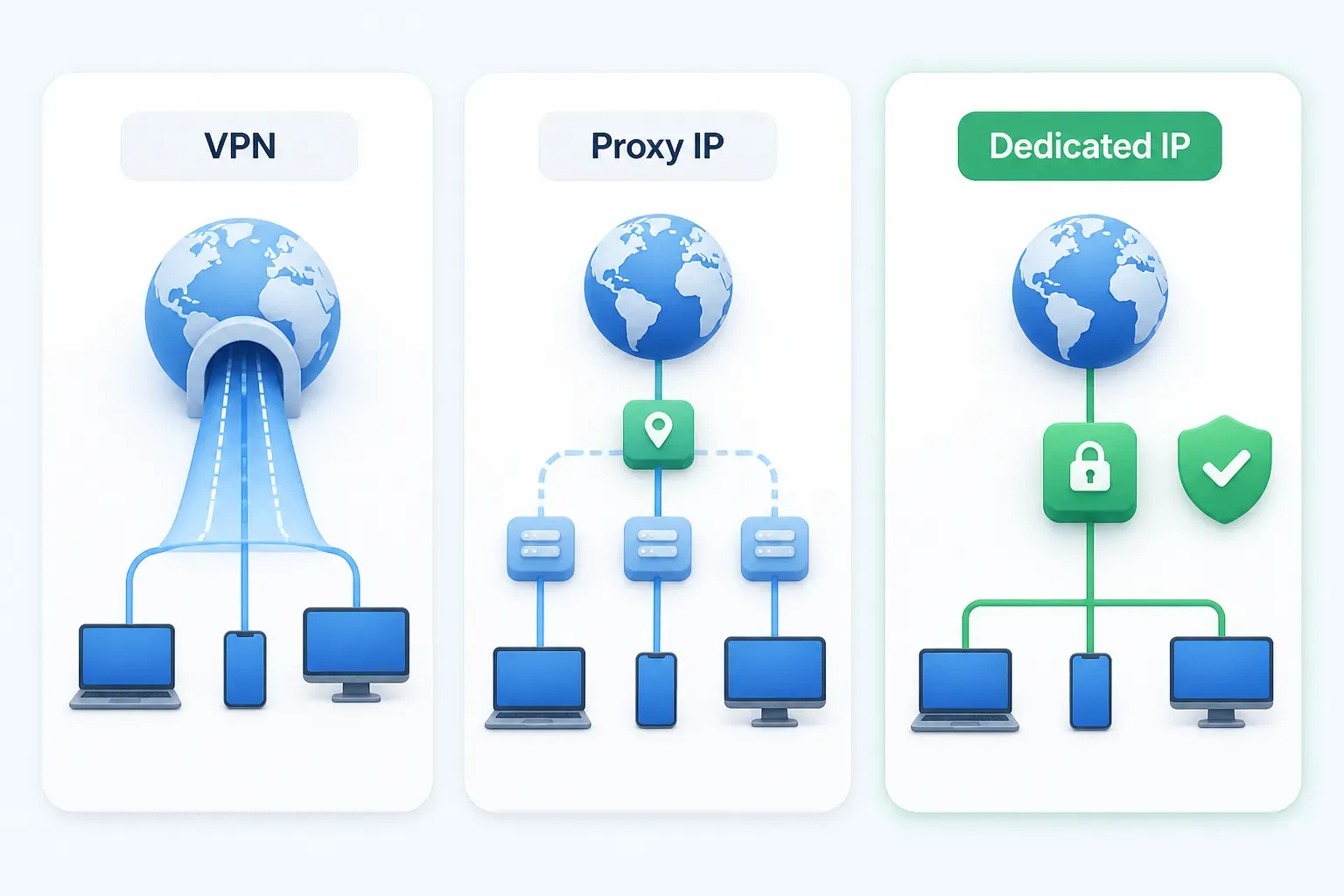
VPN
A VPN is mainly used to hide your real IP.
For everyday website browsing, this is usually enough.
However, VPNs have clear limitations in multi-account operations.
Many VPN nodes are shared public resources.
The same IP may be used by a large number of users at the same time.
Because of this, VPNs are not ideal as a long-term operating environment.
Proxy IP
Proxy IPs provide a more flexible network environment.
Depending on the type, they may include:
- Residential proxies
- Data center proxies
- Rotating proxies
- Static proxies
Different types are suitable for different business scenarios.
Many teams use proxy IPs to isolate the network environments of different accounts.
Dedicated IP
A dedicated IP usually means that an account is bound to a fixed IP address for long-term use.
Its biggest advantage is stability.
From the platform’s perspective:
An account that consistently operates in a relatively fixed environment looks more like a normal user.
Therefore, when managing multiple WhatsApp accounts over the long term, a dedicated IP is often more stable than frequently changing IPs.
How Many WhatsApp Accounts Can One IP Manage?
This is one of the most frequently asked questions.
But in reality, there is no official standard answer.
Based on the practical experience of many teams:
If the accounts have normal activity levels and healthy usage behavior,
using one IP to manage a small number of accounts usually does not cause immediate problems.
However, as the account scale grows,
the risk of running all accounts under the same IP will gradually increase.
That is why many teams choose to:
- Use different IPs for different account groups
- Use different network environments for different business departments
- Operate new accounts in independent environments
This can effectively reduce the risk of accounts being linked to one another.
Why Are More Teams Paying Attention to Account Environment Management?
In the past, many people focused on one thing:
How to get more accounts.
Now, more and more teams are focusing on something else:
How to keep accounts stable over the long term.
For foreign trade and cross-border teams,
accounts are valuable business assets.
A long-running account often accumulates:
- Customer relationships
- Chat history
- Contact resources
- Historical interaction data
Compared with constantly registering new accounts,
keeping existing accounts healthy is often far more valuable.
That is why more teams are bringing the following into one operational system:
- IP management
- Account management
- Account warm-up
Why Do Many Teams Combine IP Management with Account Warm-Up?
One obvious shift in recent years is that:
Teams have gradually realized that IP is not the only factor affecting account stability.
Account activity matters just as much.
Even with a dedicated IP environment,
if a newly registered account immediately starts contacting a large number of unknown customers,
it may still face various restrictions.
That is why many teams set up independent network environments while also building normal usage records through continuous interaction and account warm-up.
This is also why more people are starting to use tools like WAWarmer.
Unlike traditional proxy tools or anti-detect browsers, WAWarmer integrates account environment management with account warm-up.
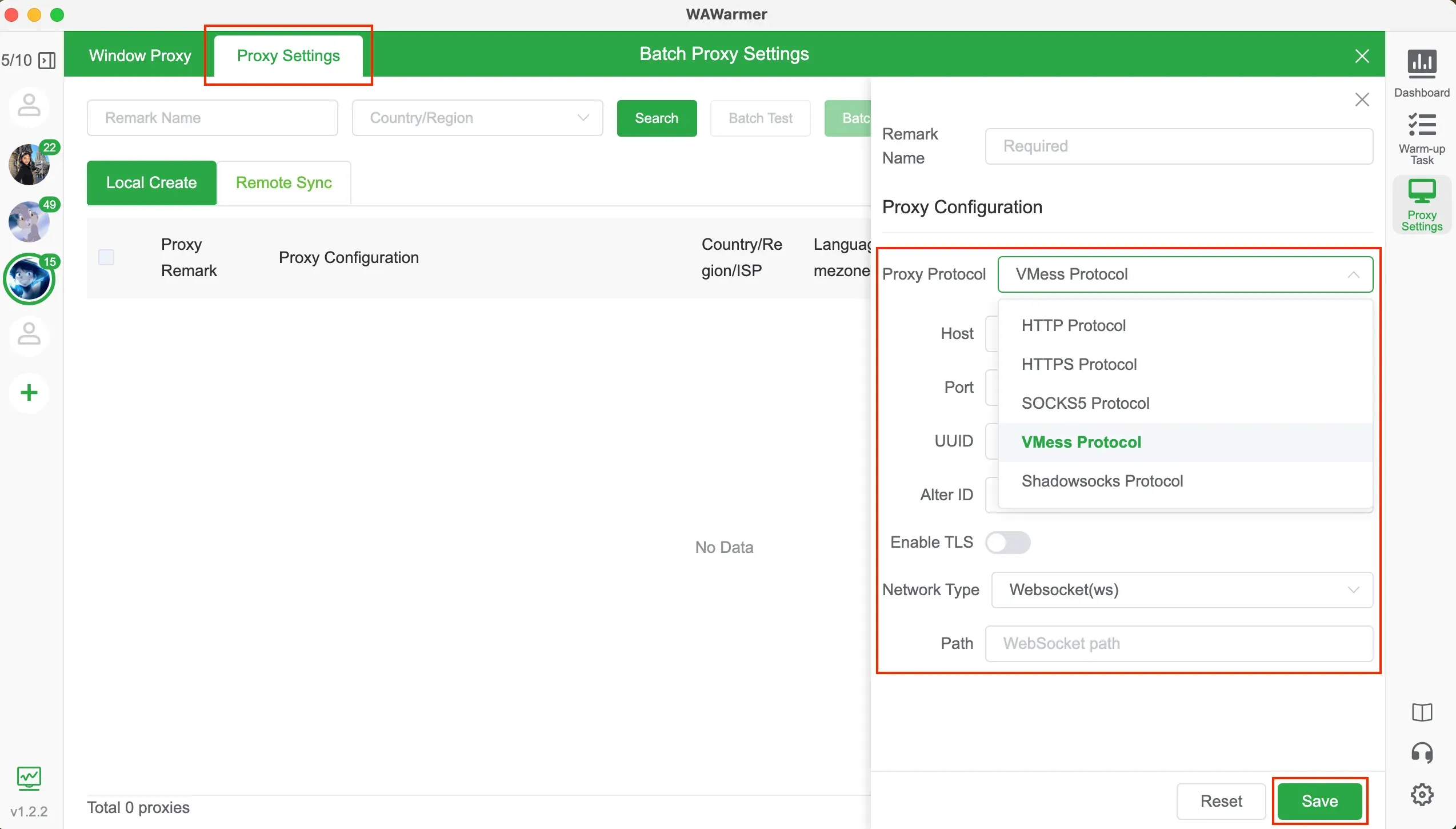
The system configures an independent fingerprint environment for each connected WhatsApp account and supports bulk proxy IP setup, helping teams build more isolated account operating environments.
If you need to configure dedicated proxy IPs for multiple WhatsApp accounts, you can use the Bulk Proxy Setup feature on the right side of WAWarmer to assign proxy resources to different accounts in one place, without configuring them manually one by one.
At the same time, with automated account warm-up, teams can maintain account activity while managing account environments, reducing a large amount of repetitive manual work.
Conclusion
For WhatsApp account operations, IP is indeed an important factor.
But it is not the only factor.
Account environment, device information, usage habits, and account activity all affect long-term account stability.
For teams managing multiple WhatsApp accounts, constantly changing IPs is less effective than building a complete account management and maintenance system.
Planning network environments properly, keeping accounts active, and managing everything through a unified tool are often more important than simply trying to obtain more accounts.
In the long run, stable account operations are far more valuable than frequently creating new accounts.
WhatsApp Account Banned? Appeal & Prevention Guide
Can a banned WhatsApp account be restored? This guide explains common reasons for bans, the Request Review appeal process, effective appeal templates, and how to reduce the risk of being banned again.
How to Manage Multiple WhatsApp Accounts Efficiently in 2026
Managing multiple WhatsApp accounts becomes challenging as teams grow. This guide explores practical WhatsApp multi account management methods, their pros and cons, and how businesses organize accounts efficiently in 2026.